
Of course! Here is a new post on the essential SaaS stack for Australian SMBs, written in the “Get Staffed” brand voice.
Your Digital Toolkit: The Top 10 SaaS Stack for Aussie SMBs
Alright, let’s talk about the digital mess that’s probably hiding in your browser’s bookmarks bar. You’ve got one tool for invoices, another for talking to the team, a clunky spreadsheet for your customer list, and about seventeen different passwords you can never remember. It’s a digital Frankenstein’s monster, stitched together with sticky tape and hope.
This “death by a thousand apps” isn’t just messy; it’s bad for business. It wastes time, creates confusion, and lets important stuff fall through the cracks.
A modern, efficient business doesn’t run on a random collection of apps. It runs on a SaaS Stack.
A SaaS (Software as a Service) Stack is a curated set of cloud-based tools that work together as the operational backbone of your company. It’s your digital headquarters, your financial controller, and your sales engine, all humming along in perfect harmony.
Choosing your stack is one of the most important decisions you’ll make. Get it right, and you’ll build a scalable, efficient machine. Get it wrong, and you’ll be stuck in a bog of lost data and wasted subscriptions.
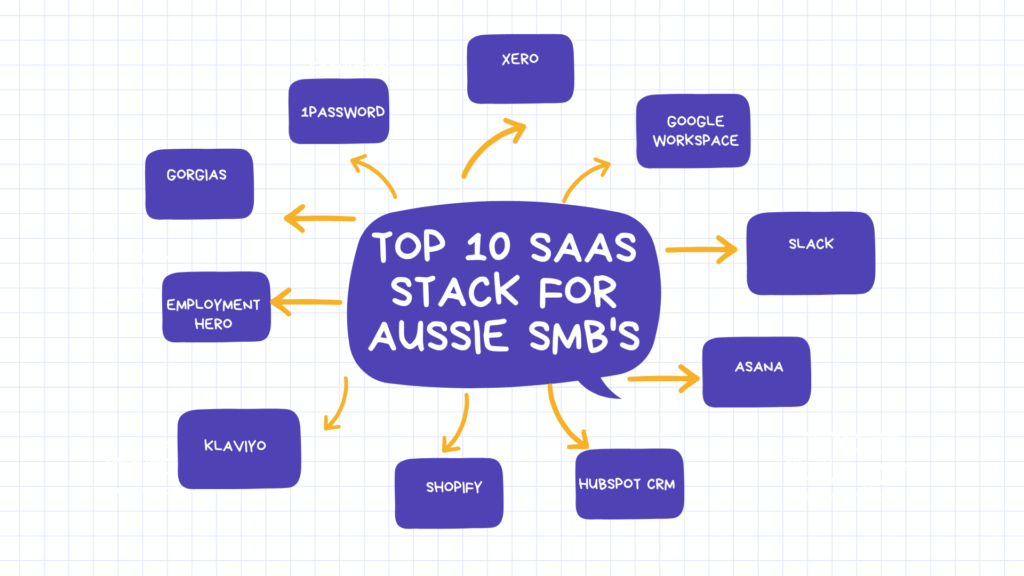
So, here’s our no-fluff, battle-tested list of the top 10 SaaS tools that should form the core of any Aussie SMB’s stack in 2025.
1. The Financial Bedrock: Xero
If your business was a house, Xero would be the concrete slab foundation. It is the undisputed king of accounting software in Australia, and for good reason. It’s built for business owners, not just accountants, making it incredibly intuitive to manage your cash flow, send invoices, and handle payroll.
Why it’s essential: It connects directly to Aussie bank accounts, automates a huge chunk of your bookkeeping, and makes BAS and tax time about a million times less painful. Its ecosystem of app integrations is massive, meaning it can talk to almost every other tool in your stack. Not using Xero in Australia is like choosing to drive on the right side of the road—you can do it, but you’re making life unnecessarily hard.
2. The Digital Office: Google Workspace
This is your command centre for day-to-day productivity. Google Workspace (formerly G Suite) gives you professional Gmail for your domain, Google Drive for cloud storage, Calendar for scheduling, and Docs, Sheets, and Slides for creating.
Why it’s essential: It’s built for collaboration. Unlike the old-school alternative, you can have five people working on the same Google Sheet in real-time without the file corrupting or creating a dozen different versions. It’s cloud-native, affordable, and just plain works. It’s the agile, modern choice for a team that needs to move fast.
3. The Digital HQ: Slack
Email is where productivity goes to die. For internal team communication, you need Slack. It’s an instant messaging platform that organises conversations into “channels” for different projects, teams, or topics.
Why it’s essential: It kills the endless email chains and makes communication faster, more organised, and more transparent. You can create a #marketing channel for campaign updates, a #customerservice channel for urgent issues, and a #random channel for memes and Friday banter. For remote and hybrid teams, it’s the virtual water cooler and the most important tool for building culture.
4. The Work Hub: Asana
A business runs on projects and tasks. Asana is where you manage all of that work. It’s a project management tool that turns chaotic to-do lists and confusing email threads into clear, actionable plans.
Why it’s essential: It answers the fundamental question: “Who is doing what, by when?” Every task has an owner, a deadline, and all the necessary information attached. It gives you a bird’s-eye view of every project in the business, from a major product launch to planning the Christmas party. It creates accountability and ensures the ball never gets dropped.
5. The Customer Database: HubSpot CRM
If you’re still managing your sales leads and customer contacts in a spreadsheet, stop. Just stop. HubSpot’s CRM is the ultimate tool for managing your relationships. And the best part? Its core CRM functionality is completely free, and powerful enough for most SMBs.
Why it’s essential: It creates a single source of truth for every interaction a customer has with your business—every email, every phone call, every purchase. This allows your sales and service teams to have informed conversations and build stronger relationships. It’s the first step to building a proper sales process.
6. The Online Shopfront: Shopify
If you sell physical products, Shopify is a non-negotiable. It is the world’s leading e-commerce platform that allows you to build a beautiful, powerful online store without needing to be a tech wizard.
Why it’s essential: It handles everything from the website and product listings to the payment gateway and shipping calculations. It’s secure, ridiculously scalable, and has an app store with thousands of tools to extend its functionality. Trying to build a custom e-commerce site in 2025 is pure madness when a platform this good exists.
7. The Marketing Engine: Klaviyo
Once you have customers, you need to talk to them. Klaviyo is the gold-standard for email and SMS marketing, especially for e-commerce businesses. It goes way beyond simple newsletters, using data to send hyper-personalised, automated messages.
Why it’s essential: It integrates seamlessly with Shopify to track customer behaviour. This allows you to set up powerful automations like abandoned cart reminders, welcome series for new subscribers, and birthday offers. It turns your email list from a simple broadcast tool into your most profitable marketing channel.
8. The Customer Lifeline: Gorgias
Happy customers stick around. Unhappy ones leave, and they tell their friends. Gorgias is a customer service helpdesk built specifically for e-commerce brands. It pulls all your customer communication—email, social media comments, live chat—into a single dashboard.
Why it’s essential: It gives your support team superpowers. They can see a customer’s entire order history right next to their support ticket, allowing them to resolve issues in seconds, not hours. It lets you provide fast, personal support that turns frustrated customers into loyal fans.
9. The People Hub: Employment Hero
Managing your team—payroll, leave, onboarding, policies—can be a huge admin headache. Employment Hero is an all-in-one HR, payroll, and benefits platform built for Aussie SMBs.
Why it’s essential: It’s designed specifically for Australian employment law, making things like superannuation and award interpretation a breeze. It automates payroll, manages leave requests, and gives your team a self-service portal to access their payslips and personal information. It’s a local hero that slashes your HR admin time.
10. The Digital Vault: 1Password
Your business runs on passwords. Dozens, if not hundreds of them. Using the same one everywhere or storing them in a spreadsheet is a security disaster waiting to happen. 1Password is a password manager that creates, stores, and fills strong, unique passwords for all your accounts.
Why it’s essential: It’s the single most important tool for protecting your business from cyber threats. It allows you to securely share login details with your team without ever revealing the actual password. In an age of constant data breaches, it’s the cheap, simple insurance policy your business cannot afford to go without.
Build Your Stack, Build Your Business
There you have it. A lean, mean, modern SaaS stack that covers every critical function of your business. These tools talk to each other, they save you countless hours of manual work, and they provide the data you need to make smarter decisions.
Stop duct-taping random apps together. It’s time to be deliberate. Invest in a proper stack and build the operational foundation your business deserves.