
Alright, let’s have a straight-up chat. You, the savvy Aussie business owner, are juggling a million things. You’re the CEO, the head of sales, the IT department, and occasionally the one who has to unblock the loo. The last thing you need is a revolving door of staff, draining your time, money, and your will to live.
You’ve been there, right? You hire someone who looks brilliant on paper, only for them to flounder. Or you find a superstar, but they burn out and leave within a year because their role was as clear as mud. It’s frustrating, expensive, and makes you want to pack it all in and go run a coffee van in Byron Bay.
The problem isn’t always the person. More often than not, the problem is the role itself was never properly built. It was a fuzzy idea, a list of tasks scribbled on a napkin, a desperate plea for “someone to just handle the social media stuff.”
This is where most businesses go wrong. They hire for a person to fill a gap, not for a well-defined role to achieve a strategic objective.
Enter the Role Blueprint.
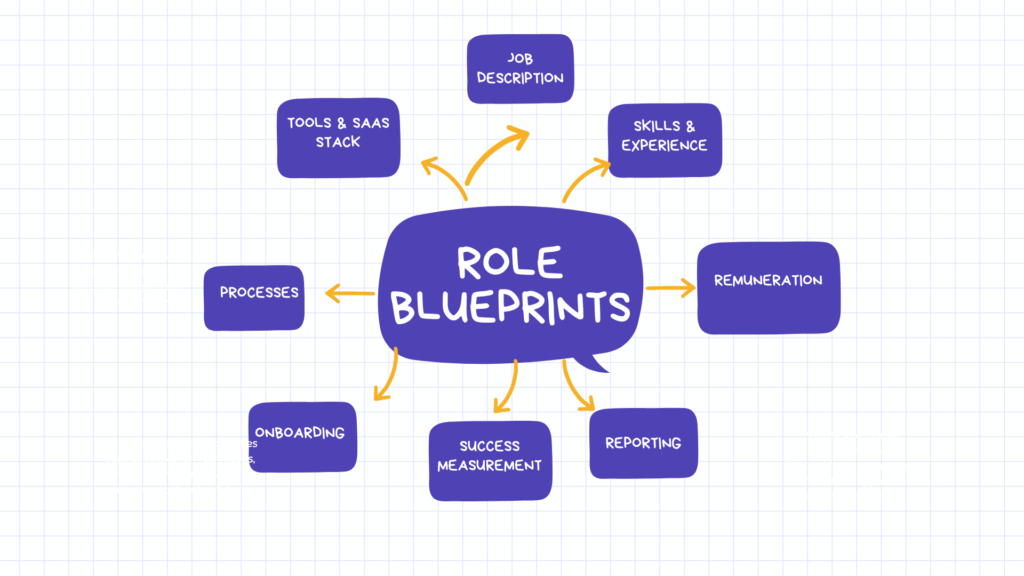
This isn’t just a fancy term for a job ad. A Role Blueprint is the architectural plan for a position in your company. It’s the single source of truth that defines every critical component of a role, ensuring that you, your team, and your new hire are all on the same page, singing from the same hymn sheet, and rowing in the same bloody direction.
We originally called this the “7 Elements,” but like any good Aussie BBQ, we got a bit excited and threw an extra snag on the grill. So, here are the 8 essential elements that make up a rock-solid Role Blueprint. Get this right, and you’ll stop hiring bodies and start building a high-performance team.
We’ll use the example of a Social Media Manager for a growing e-commerce business to bring each element to life.
Element 1: The Job Description (The “Why Should I Even Bother?”)
What It Is
The Job Description is your sales pitch. It’s the movie trailer for the role. It goes far beyond a boring list of “duties and responsibilities.” A great Job Description answers three fundamental questions for a potential candidate:
- What’s the mission? Why does this role exist? What grand purpose will I be contributing to?
- What will I actually do? What does a day, week, and month in this role look like?
- What’s the company culture like? Am I joining a buttoned-up corporate machine or a dynamic team of innovators who enjoy a bit of banter?
It’s your first, best chance to attract the right kind of person and politely scare off the wrong ones.
Why It’s Critical
A vague job description attracts vague candidates. If you write “Manage social media channels,” you’ll get applications from people whose only experience is posting holiday snaps on their personal Instagram. A detailed, compelling description acts as a filter. It speaks directly to the A-players who are looking for a meaningful challenge, not just a paycheque. It sets the tone and the expectations from the very first interaction.
Example: Social Media Manager
A Bad, Vague Job Description:
- Manage Facebook and Instagram.
- Create posts.
- Reply to comments.
- Must have social media experience.
A Solid Role Blueprint Job Description:
Role: Social Media & Community Manager
Mission: To build a vibrant, engaged community of brand advocates around our e-commerce store. You won’t just be posting content; you’ll be the voice of our brand, turning casual followers into loyal customers and telling our story in a way that resonates deeply with our audience. Your mission is to grow our brand’s reach and drive meaningful traffic that converts.
A Day in the Life Might Look Like:
- Crafting and scheduling a week’s worth of compelling content (carousels, Reels, stories) for Instagram and TikTok that aligns with our current marketing campaign.
- Diving into the comments and DMs, not just as a moderator, but as a community builder, sparking conversations and providing exceptional customer service.
- Collaborating with our graphic designer and marketing manager in a morning WIP to brainstorm ideas for our upcoming product launch.
- Analysing last week’s performance data to see what content hit the mark and what flopped, and using those insights to inform your strategy for the weeks ahead.
- Identifying and engaging with user-generated content and potential brand ambassadors.
Element 2: Skills & Experience (The “Have You Got the Goods?”)
What It Is
This is where you get specific about the capabilities required to actually succeed in the role. It’s crucial to split this into three distinct categories:
- Hard Skills (The Non-Negotiables): These are the technical, teachable abilities. The person must have these to even be considered.
- Soft Skills (The Culture Fit): These are the interpersonal traits and attributes. How they work, communicate, and solve problems. You can hire for skill, but you fire for attitude. This part is vital.
- Experience (The Track Record): What level of proven experience do they need? Be specific about the type of experience, not just the number of years.
Why It’s Critical
Without this clarity, you’ll waste countless hours interviewing people who are fundamentally unqualified. Separating “must-haves” from “nice-to-haves” allows you to be flexible. Maybe you’d trade 5 years of experience for a candidate who is a genius with video editing and has an incredible can-do attitude. This element helps you build a scorecard for evaluating candidates objectively, removing bias and “gut feelings” that often lead to bad hires.
Example: Social Media Manager
Hard Skills (Must-Haves):
- Expert proficiency with Meta Business Suite, TikTok, and LinkedIn.
- Proven copywriting skills with an ability to nail our brand’s cheeky-but-helpful tone of voice.
- Intermediate to advanced skills in Canva and/or Adobe Express for content creation.
- Experience with a social media scheduling tool (e.g., Buffer, Sprout Social).
- Ability to interpret social media analytics and create insightful reports.
Soft Skills (Must-Haves):
- High emotional intelligence: You can read the room, handle grumpy customers with grace, and know when to be funny vs. when to be serious.
- Insane creativity: You see content ideas everywhere and aren’t afraid to try something new.
- Resilience: You understand that not every post will be a winner and that social media can sometimes be a tough crowd. You can take feedback and bounce back.
- Proactive communicator: You don’t wait to be asked for an update; you keep stakeholders in the loop.
Experience:
- Required: Minimum 3 years in a social media role for a B2C brand, preferably in e-commerce.
- Required: A portfolio of work demonstrating your ability to grow an engaged community and create high-quality content (please include a link in your application).
- Nice to Have: Experience running paid social campaigns.
- Nice to Have: Basic video editing skills for creating Reels/TikToks.
Element 3: Remuneration (The “Show Me the Money!”)
What It Is
This is more than just a salary figure. The Remuneration Structure is the total value proposition you are offering. It includes:
- Base Salary: The fixed amount they get paid.
- Superannuation: The legally required contribution (don’t forget this!).
- Performance-Based Bonuses: Any incentives tied to achieving specific goals (KPIs).
- Perks & Benefits: The non-cash extras that make your company a great place to work (e.g., flexible hours, WFH allowance, professional development budget, team lunches).
Why It’s Critical
Transparency is king. Being upfront about remuneration builds trust from the outset and stops you from wasting time with candidates whose expectations are way out of line with your budget. A well-structured package shows you’ve thought about how to motivate performance. Tying bonuses to the Success Measurement element (more on that next) creates a powerful alignment between the employee’s success and the company’s success.
Example: Social Media Manager
- Base Salary
- Australia:
- $75,000 – $90,000 per annum, depending on experience.
- Superannuation: 12% (Note: As of July 2025, the Superannuation Guarantee is legislated to be 12%. It’s good practice to show you’re on top of this)
- $75,000 – $90,000 per annum, depending on experience.
- Philippines:
- Expect to pay AUD$17,000 to $25,000 per annum
- Australia:
- Performance Bonus: Up to 10% of base salary, paid quarterly, based on achieving KPIs. 50% tied to community engagement growth targets, 50% tied to generating qualified leads from social channels.
- Perks & Benefits:
- Flexible working arrangements (3 days in our Surry Hills office, 2 days from home).
- $1,000 annual professional development budget for courses, conferences, etc.
- Monthly team-wide social events.
- Staff discount on all our awesome products.
Element 4: Reporting Structure (The “Who’s the Boss?”)

What It Is
This element clarifies where the role sits within the organisational food chain. It’s not about hierarchy for the sake of it; it’s about clarity of communication and decision-making. It should clearly define:
- Direct Manager: Who do they report to for day-to-day guidance, feedback, and approvals?
- Direct Reports: Is this person managing anyone?
- Key Collaborators: Who are the other people or departments they need to work with closely to succeed?
Why It’s Critical
Ever been in a job where you had three different bosses giving you conflicting instructions? It’s a recipe for disaster. A clear reporting structure prevents confusion, eliminates bottlenecks (“I’m waiting for approval from… someone?”), and empowers the employee to know who to go to for what. For collaborators, it establishes that their relationship is one of partnership, not authority.
Example: Social Media Manager
- Direct Manager: This role reports directly to the Head of Marketing. You will have weekly 1-on-1 meetings to discuss strategy, performance, and professional development.
- Direct Reports: This is currently a standalone role with no direct reports.
- Key Collaborators:
- You will work daily with our Graphic Designer to create visually stunning assets.
- You will collaborate weekly with the E-commerce Manager to align social campaigns with product promotions.
- You will liaise with the Customer Service Team to ensure a consistent brand voice and to escalate any complex customer issues that arise on social media.
Element 5: Success Measurement (The “How Do We Know You’re Winning?”)
What It Is
This is arguably the most important element of the entire blueprint. If the Job Description is the promise, Success Measurement is the proof. This is where you define, in black and white, what a great job looks like. Forget vague statements like “increase brand awareness.” We’re talking about specific, measurable, achievable, relevant, and time-bound (SMART) goals. These are the Key Performance Indicators (KPIs) for the role.
Why It’s Critical
This element transforms a role from a list of tasks into a results-driven position. It gives the employee a crystal-clear target to aim for. It makes performance reviews objective and data-driven, not based on feelings. It ensures that the person’s daily activities are directly contributing to the company’s overarching business goals. When your Social Media Manager knows their bonus is tied to lead generation, they’ll stop posting cat memes (unless you sell cat products) and start thinking about conversion.
Example: Social Media Manager
Success in this role will be measured by the following KPIs, reviewed on a monthly and quarterly basis:
- Community Growth & Engagement (40%):
- Increase average Instagram post engagement rate from 2.5% to 4% within 6 months.
- Grow our TikTok following by 500 genuine, relevant followers per month.
- Maintain a 24-hour response time for all DMs and comments.
- Traffic & Lead Generation (40%):
- Drive 1,500 qualified website sessions per month from social channels (measured via UTM-tagged links in Google Analytics 4).
- Generate a minimum of 75 email list sign-ups per month attributed to social media campaigns.
- Content Performance (20%):
- Achieve an average of 5,000 views per Reel/TikTok video.
- Successfully conceptualise and launch one major content campaign per quarter (e.g., a user-generated content contest, an influencer collaboration).
Element 6: Onboarding (The “Setting You Up for Success”)
What It Is
Onboarding is the process of getting your new hire up to speed and integrated into the company. It is NOT just giving them a laptop and a password on day one and saying, “Good luck, mate!” A proper onboarding plan is a structured 30-60-90 day roadmap that covers systems, processes, people, and culture.
Why It’s Critical
The first 90 days are make-or-break for a new hire. A great onboarding experience dramatically increases employee engagement, productivity, and long-term retention. A poor one leaves them feeling isolated and confused, leading to a quick exit. By mapping out their first few months, you remove anxiety and provide a clear path for them to start adding value quickly.
Example: Social Media Manager
The First 90-Day Onboarding Plan:
- First 30 Days (Learning & Absorbing):
- Week 1: Get set up on all systems. Meet-and-greets with all key collaborators. Deep-dive into our brand guidelines, target audience personas, and past social media performance reports. Your main task is to listen, learn, and ask a million questions. You will shadow the Head of Marketing on current social media tasks.
- Weeks 2-4: Take over daily community management (responding to comments/DMs). Create your first content proposals for review. Present a ‘state of the nation’ report on your observations of our current social media presence and initial ideas for improvement.
- First 60 Days (Executing & Owning):
- Take full ownership of the content calendar and daily posting schedule.
- Launch your first small-scale campaign (e.g., an Instagram Story series).
- Set up your performance tracking dashboard to monitor your KPIs.
- Present your first monthly performance report to the marketing team.
- First 90 Days (Strategising & Innovating):
- Develop and present your strategic plan for social media for the next quarter.
- Identify and pitch 2-3 new content formats or channel opportunities (e.g., starting a YouTube Shorts series).
- Have fully established a smooth collaborative workflow with the Graphic Designer and other team members.
Element 7: Processes (The “How We Do Things ‘Round Here”)
What It Is
Processes are your business’s secret sauce. They are the Standard Operating Procedures (SOPs) that ensure consistency, quality, and efficiency. For any given role, this means documenting the key workflows they will be responsible for. It’s the “how-to” guide for their job.
Why It’s Critical
Without documented processes, your business relies on “tribal knowledge” locked inside one person’s head. When that person goes on holiday (or leaves), chaos ensues. Documenting processes makes the role scalable, trainable, and less dependent on a single individual. It empowers a new hire to find answers for themselves and ensures that tasks are completed to the same standard, every single time.
Example: Social Media Manager
Key processes for this role that must be followed and documented include:
- The Content Creation Workflow:
- Idea: Add content idea to the ‘Ideas’ column in Asana.
- Draft: Write copy and creative brief.
- Design: Assign to Graphic Designer with a clear deadline.
- Review: Submit final asset and copy to the Head of Marketing for approval (24-hour turnaround required).
- Schedule: Once approved, schedule the post in Buffer.
- Engage: After posting, monitor the post for the first 60 minutes to respond to initial comments.
- The Crisis Management Process:
- A step-by-step guide on how to handle a wave of negative comments, including when to respond, when to hide, when to delete, and when to immediately escalate to the Head of Marketing.
- The Monthly Reporting Process:
- A checklist for pulling data from all relevant platforms, the template to use for the report, and the agenda for the monthly performance meeting.
Element 8: Tools & SaaS Stack (The “Tools of the Trade”)
What It Is
This element lists the specific software, tools, and platforms the person will be expected to use to perform their job. From communication tools to specialist software, this is their digital toolbox.
Why It’s Critical
Listing the tech stack sets clear expectations. If you require proficiency in a specific tool, it should have been mentioned in the ‘Skills’ section; this is where you confirm the exact stack they’ll be working with. It also helps you, the business owner, to audit your SaaS subscriptions and ensure you’re providing the best tools for the job. Advertising that you use modern, efficient tools can also be a selling point for savvy candidates.
Example: Social Media Manager
You will be given access to and expected to become proficient in the following tools:
- Social Media Management: Buffer (Premium Plan)
- Project Management & Collaboration: Asana
- Team Communication: Slack and Google Workspace (Gmail, Drive, Meet)
- Content Creation: Canva (Teams Account), CapCut (for video)
- Analytics: Google Analytics 4, and the native analytics suites of each social platform.
Putting It All Together: From Chaos to Clarity
Look at those 8 elements. They’re not separate, isolated documents. They are a single, cohesive system.
- Your Job Description (1) attracts someone with the right Skills (2).
- Your Remuneration (3) is competitive and motivates them towards the goals defined in your Success Measurement (5).
- The Reporting Structure (4) clarifies who sets those goals and who they work with.
- Your Onboarding (6) teaches them the Processes (7) and Tools (8) they need to hit the ground running and achieve success.
See how it all links together? A weakness in one area undermines the whole structure. A superstar hire with no onboarding will fail. A clear set of KPIs with no processes to support them is just a wish list.
Building a Role Blueprint takes time upfront. It forces you to think deeply about what you really need. But the payoff is immense. You move from reactive, panicked hiring to proactive, strategic team building. You create clarity, reduce friction, and empower your people to do their best work.
So before you post that next job ad on SEEK, take a breath. Give the role the respect it deserves. Build the blueprint first. Your future superstar employee—and your sanity—will thank you for it.
Ready to stop gambling on hires and start building a team of A-players? Start building your first Role Blueprint today. You’ve got this.